

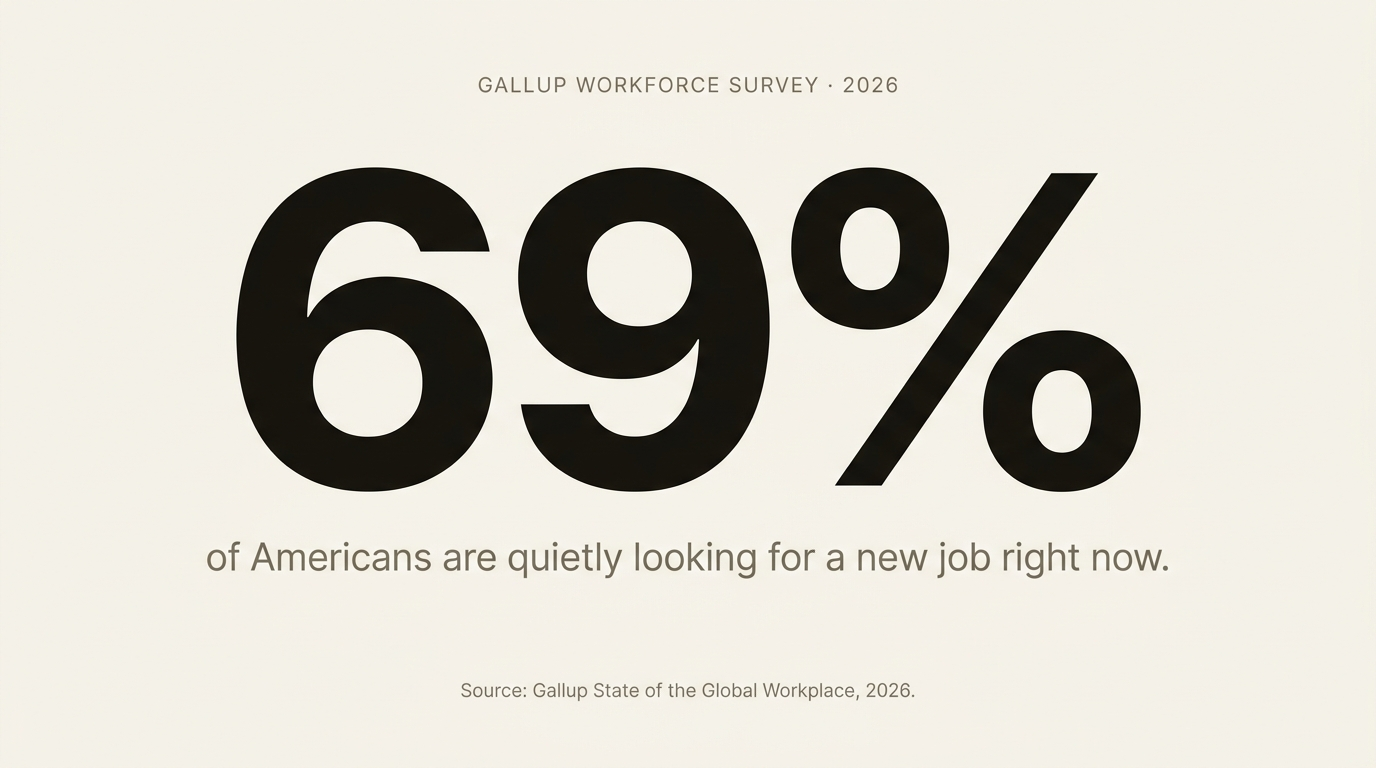
A Gallup survey released earlier this year found that 69% of American employees are actively looking for a new job or watching for opportunities. Seven out of ten people.
Which means if you’re sitting in a meeting right now, quietly doing the math on whether you could afford to leave, statistically speaking, at least four of the other people in that room are doing exactly the same thing.
Nobody talks about it. But the reason why is more uncomfortable than most people expect.
Nobody Announced It. But the Deal You Agreed To Is Gone.
The past three years quietly dismantled a set of assumptions most professionals had spent a decade building.
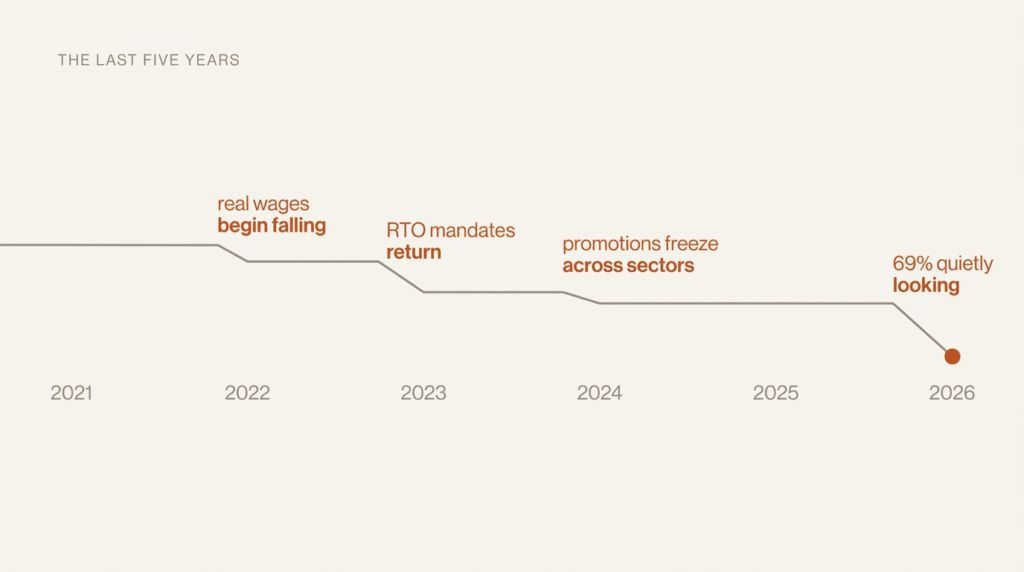
Salaries that felt solid in 2021 have lost real purchasing power every year since, with no meaningful correction. Return-to-office mandates reversed arrangements people had restructured their entire lives around — commutes came back, flexibility disappeared, and compensation never moved to reflect it. Growth paths that once felt clear got frozen, reorganised, or quietly eliminated.
None of this happened loudly. There was no single moment. It was a slow accumulation of small reversals — each one manageable on its own — until one day you added them up and realised the job you’re in is no longer the deal you originally agreed to.
That’s not ingratitude. That’s not restlessness. That’s a reasonable response to facts that have genuinely changed.
The top three reasons the 69% are looking:
🔵 Salary stagnation — real wages down 3 consecutive years with no correction in sight
🔵 Return-to-office reversals — flexibility removed, commute reinstated, nothing added in return
🔵 Blocked growth — promotion paths frozen, reorgs eliminating the rungs people were climbing toward
Three things shifted. But only one of them is actually keeping people stuck — and it’s not the job market.
Why Most People Stay in Jobs They’ve Already Decided to Leave
Most people have wanted to look for a while. The problem is the distance between wanting to look and actually looking — and how much that distance demands from someone who is already spent.
Think about what a job search actually requires when you’re already employed.
You come home from a full day. You have some version of dinner, some version of winding down, and then somewhere in what’s left of the evening you’re supposed to summon the focus to research companies, find relevant postings, tailor a resume, write a cover letter that sounds confident without sounding desperate — and submit it, knowing the chance of hearing anything back is statistically low.
Then do it again tomorrow. And the day after.
Most people manage a burst of this. A week, maybe two. Then life absorbs the time, the energy thins out, and the job search quietly moves from active priority to background guilt. The hum of knowing you should be doing something becomes the permanent background noise of a career that isn’t moving.
You open a job board at 10pm. Forty minutes later you’ve applied to one role, half-finished something for a second, and bookmarked six others you’ll never go back to. You close the laptop feeling like you’ve done something. By Thursday the bookmarked roles have closed. You start again.
Applications go out one at a time, into silence. Most people assume the silence means something about them.
It doesn’t.

What Nobody Tells You About the Moment You Hit Submit
Here’s where the story gets uncomfortable.
The moment you submit, your resume doesn’t land on a hiring manager’s desk. It enters an applicant tracking system — software that scans applications for keyword matches before any human reviews them. Most companies use one. Fortune 500 companies run every single application through one without exception.
The system isn’t reading your resume the way you wrote it. It’s scanning for specific terms, specific structures, specific signals — and anything that doesn’t match gets filtered out automatically before anyone clicks read.
The numbers behind this are hard to ignore:
🔴 80% of resumes are eliminated by ATS before a human sees them
🔴 1 in 20 applications ever reaches the hiring manager’s desk
🔴 6 seconds of submission – that’s how fast most of the rejections happen
The 69% aren’t failing to get callbacks because they’re unqualified. A significant portion are losing to a filter they didn’t know existed, with a resume that was never built for the system judging it.
The advice people get when this happens makes it worse:
❌ “Customise your resume even more”
❌ “Write a stronger cover letter”
❌ “Be patient and persistent”
❌ “Network harder on LinkedIn”
None of it addresses the actual problem. You can write a perfect cover letter for an application that gets eliminated in the first automated pass. Patience doesn’t help with a system that doesn’t care how long you wait.
You’ve been optimising the wrong thing.
And the people getting callbacks right now know exactly what is actually important.

How to Change the Equation in 2026
The ones getting through right now aren’t better candidates. They’re not writing stronger cover letters or spending more time on applications. They’re using tools that were built for how hiring actually works in 2026 — not how it worked ten years ago.
Instead of spending hours searching, rewriting, and waiting, automation tools like BetterApply exist specifically to handle high-velocity hiring periods.
Here’s how it works in practice:
⚫ Step 1 — It finds the roles for you. You tell BetterApply what you’re looking for: the role, the level, the industry, remote or in-person. From there it runs continuously — surfacing matching openings the day they post, without you checking anything. No endless scrolling. No fear of missing something while you were busy living your life.
⚫ Step 2 — Applications go out automatically. When a match appears, BetterApply builds a tailored, ATS-optimised resume for that specific posting — structured around how that job description will be filtered, so it reaches a person instead of dying in a queue. Then it submits. You see everything it applies to. You stay in control of what moves forward.
⚫ Step 3 — Consistency stops depending on energy. Instead of bursts of effort followed by weeks of nothing, applications run steadily in the background. On days when life takes everything you have, the process keeps going anyway. That’s the part most people never manage manually — not because they don’t want to, but because sustained consistency is impossible when you’re running on empty.
That’s the mechanical part.
But there’s a side effect nobody talks about and it’s the one that changes everything.
The Part Nobody Talks About (This is BIG)
There’s an advantage to this approach that has nothing to do with resumes or filters.
It’s psychological.
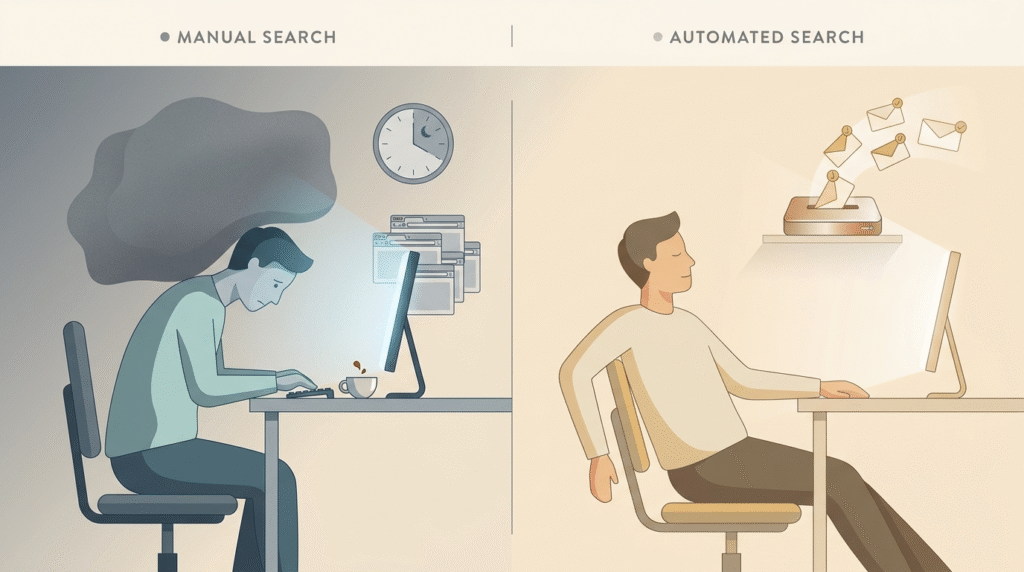
When applications run automatically, you stop tying your mood to your inbox. A quiet week stops feeling like personal failure. You stop over-editing the same resume at midnight looking for the thing that must be wrong with it. You stop quitting after a slow stretch.
And when interviews start coming in — which they do, once the volume is there and applications are actually reaching people — they feel less like a lifeline and more like a normal outcome from a process that was working the whole time.
Which raises one question:
If the only difference between staying stuck and moving forward is knowing this, then..
What are you actually waiting for?
The 69% Are Just Waiting. You Are Already Ahead.
You just read what most of your colleagues don’t know. That the system filters before any human sees you. That spring is the highest-pressure hiring window of the year. That the people getting callbacks aren’t better — they’re just inside a process that actually reaches people.
That’s the advantage. You have it right now.
The only question is whether you use it.
Three minutes to set up.
Runs in the background.
You’ll know exactly what’s out there and what you’re worth – within the week.
⭐️ LIMITED-TIME OFFER ⭐️
BetterApply is giving a special -60% discount to readers of this article.
To get your discount, click the link below.
Get hired faster with BetterApply
CLAIM YOUR DISCOUNT